


Marketing shot from San Francisco-based scooter company Lime. Scooter users, in reality, are disproportionately rich, white and male, finds the inaugural NABSA “state of the industry” report
Shared micromobility such as e-scooters and shared bikes are disproportionately used by young well-educated rich white men, while the poor, black, female, elderly and less educated are significantly under-represented in the North America user base, according to leading industry association the North American Bikeshare Association (NABSA).

NABSA’s study shows shared mobility users to be disproportionately rich, white and male
NABSA’s inaugural annual report, Shared Micromobility State of the Industry Report, examined the average amount by which shared micromobility users are over- or under-represented against demographics in their city.
For both shared bikes and shared e-scooters, a pattern quickly emerges. “Compared to the populations of the cities they operate in, shared micro-mobility users are disproportionately young (particularly age 25 to 44), white, male, have higher incomes and have higher levels of education” says the report.
Women, for example, were 22 points under-represented on shared bikes; those with high school education were 28 points under-represented on the same, while those with advanced degrees were 28 points over-represented.
Interestingly, says the survey, “the lowest income bracket (less than US$15,000 per year) is proportionately represented. It is possible that income-based equity programs are contributing to this pattern.”
30 million hours of exercise
But while this skewed user base may give planners and advocates pause for thought, the NABSA report has plenty of good news too.
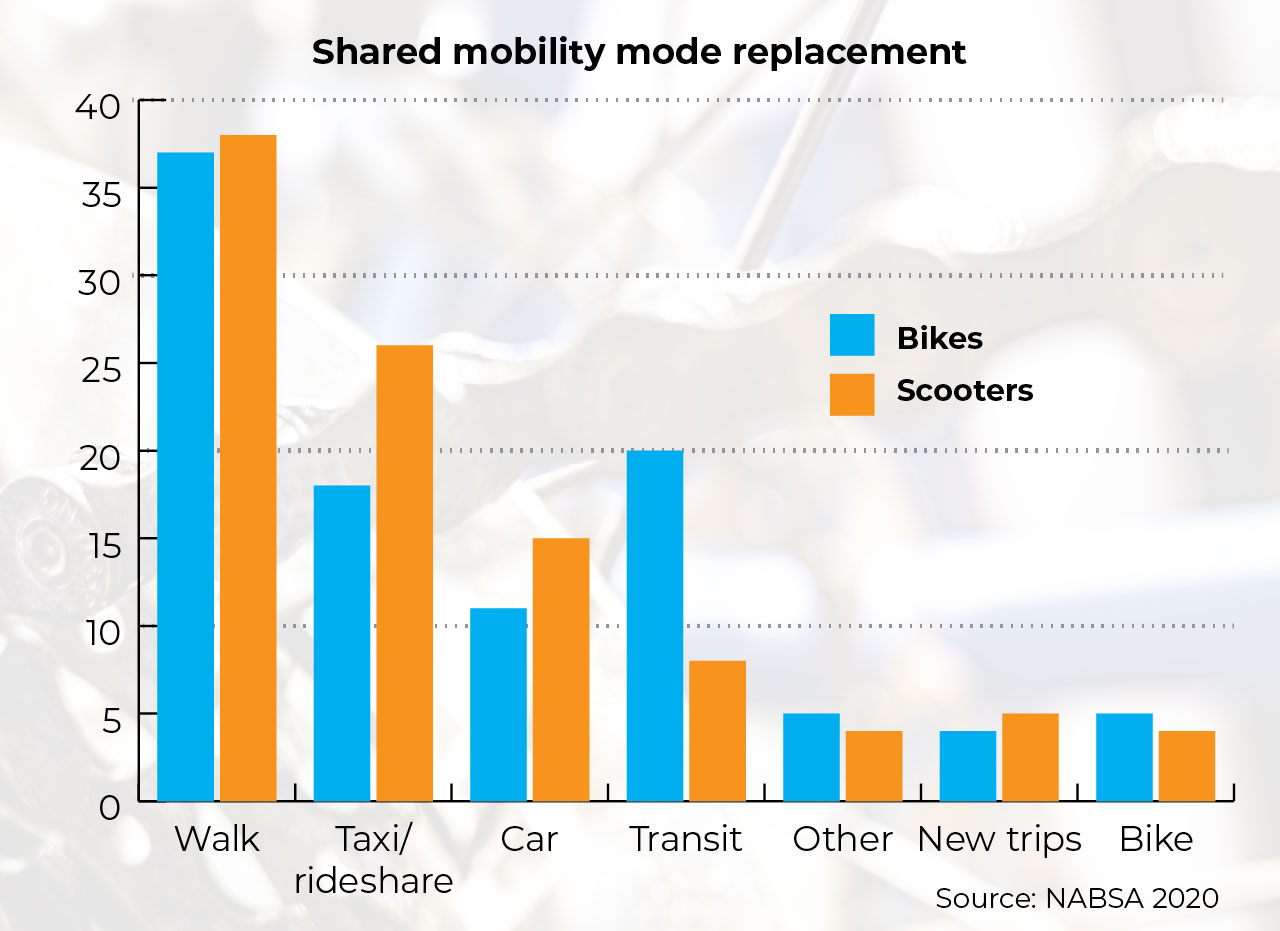
Over a third of shared micromobility trips in the US replace a car trip
Over a third of 157 million shared micromobility trips in the USA in 2019 replaced a car trip, with shared micromobility adding 30 million hours of physical activities to North American lives in 2019.
NABSA estimates around 13.1 million hours were added on pedal bikes, 1.4 million hours on e-bikes and 156.2 million hours on e-scooters.
Across the whole US, the average shared micromobility vehicle was used for nearly three trips per service day. “The average trip was 1.3 miles long and lasted for 23 minutes. E-scooters had somewhat higher utilization than bikes, while bikes had longer trip distances and durations,” says the NABSA report.
The report also demonstrates the widespread adoption of the General Bikeshare Feed Specification (GBFS), an open data standard managed by NABSA and MobilityData that enables app-based trip-planning with shared mobility vehicles. “In 2019, 56% of North American cities required GBFS. NABSA will be releasing further education and guidance for municipalities about GBFS later this year,” says NABSA.