
Spot the $10 million light? The government’s new red-light projectors do not work in daylight (unedited photo of Sha Tin Centre Street pedestrian red-light projector installations at lunchtime this week).
A Transit Jam study has found 100% of “red light projectors” being rolled out by Transport Department (TD) are non-functional in daylight or obstructed, raising questions on a government-commissioned $330,000 University of Hong Kong (HKU) study which claimed the lights were highly effective at cutting red-man crossings (RMCs).

At the original pilot site, contractors have covered the projector with tarpaulin, rending it invisible on the ground even at night.
The government is spending $9.59 million on rolling out 1,600 more of SupremeTech’s red light projectors following HKU’s research on the pilot project of seven installations. The secretive HKU research report, which neither TD nor HKU would share, claims to have observed a 25% reduction in RMCs at seven pilot installations.
Those startling figures came as a surprise to some road-safety campaigners, who had raised the alarm on the visibility of the projected lights since their introduction.
The systems project a red light onto the ground, with the aim of alerting those pedestrians who may be looking down at their phones or not paying attention to red man/green man signals. But the light cannot be seen in daylight: even SupremeTech’s own LinkedIn post promoting the projectors features only shots in the dark.

The maker’s LinkedIn post only features night shots of the controversial technology
Aside from finding the invisibility problem, Transit Jam’s research, counting over 6,000 pedestrians crossing the roads, found HKU’s results impossible to corroborate. Even when measuring at dusk, night or under heavy cloud, when the red projector lights were visible, we could not find anything close to the 25% RMC reduction claimed by the government’s paid researchers.
For our own study, we visited 13 crossings from Tsuen Wan to Wan Chai, including all seven apparently investigated by the HKU study, counting a total of 6,244 pedestrians.
100% of installed projector lights at crossings investigated by HKU were invisible from early morning until dusk. We also found one light projector and red man from the very first pilot installation on Percival Street illegally covered by scaffolding: residents say the tarpaulins have covered the pedestrian lights for almost a year.

While HKU’s government-funded research found a strong impact from the installed projectors, we could not replictate their results
For all those crossings with the projector lights fitted, we found an average RMC rate of 19.7%, whether the red lights were visible or not.
For the seven specific crossings included in the HKU study, we found a total RMC rate of 16.0% when the lights were invisible and 15.6% when the lights were visible: a 2.5% improvement when the projector lights were visible at those crossings.
HKU claims to have observed an RMC rate of 26.4% at these same crossings before the lights were installed, with that figure improving to 19.6% after the red-light projectors were installed. As such, they calculate a 25% improvement in RMCs, a figure used to justify the 1,600 new sets of projector lights.
In other words, government-paid researchers found the improvement from the pilot scheme to be an order of magnitude greater than our independent research.
While Transit Jam’s total study looked at only a third of the total number of pedestrians HKU counted (6,244 against 20,800 for HKU), we saw no reason why longer counts would change the results, with consistent RMC rates observed at each crossing over each counting session.
TD says the $330,000 HKU research, which is not listed on its contract or tender page, was commissioned “following established procurement procedures”.
With the government keeping the research methodology in the dark, we don’t know if researchers factored in the “visibility” of the red light in their research and whether they counted an invisible light as a successful installation.
We also don’t know if traffic light timings were changed after the installation of the projectors: we found light cycles had a big impact on pedestrian behaviour. At one crossing in Wan Chai, for example, the light cycle is extremely short, at around 30-40 seconds. This, coupled with a heavy vehicle traffic flow at that crossing, keeps RMCs very low, at around 3%.
Likewise at one of the study sites in Tsuen Wan, the light cycle is short and a “beg button” offers near-instantaneous “green man” if pushed. As such, and with lighter vehicle traffic on that street, RMCs were well below the city average, at just 10.7% with no projector light visible.
Projectors increase red-man crossings
Our findings broadly tally with international research into such projector schemes. One peer-reviewed study by the University of Nottingham, as one example, found that around 90% of pedestrians simply ignored such projector lights.
But one interesting finding from our research and observation was that, in some cases, distracted pedestrians noticed the lights, checked for traffic and then crossed against the light.
This indicates the lights do have road safety value in triggering a traffic check: but the measure of that value is not in the “jaywalking” rates TD relied upon.
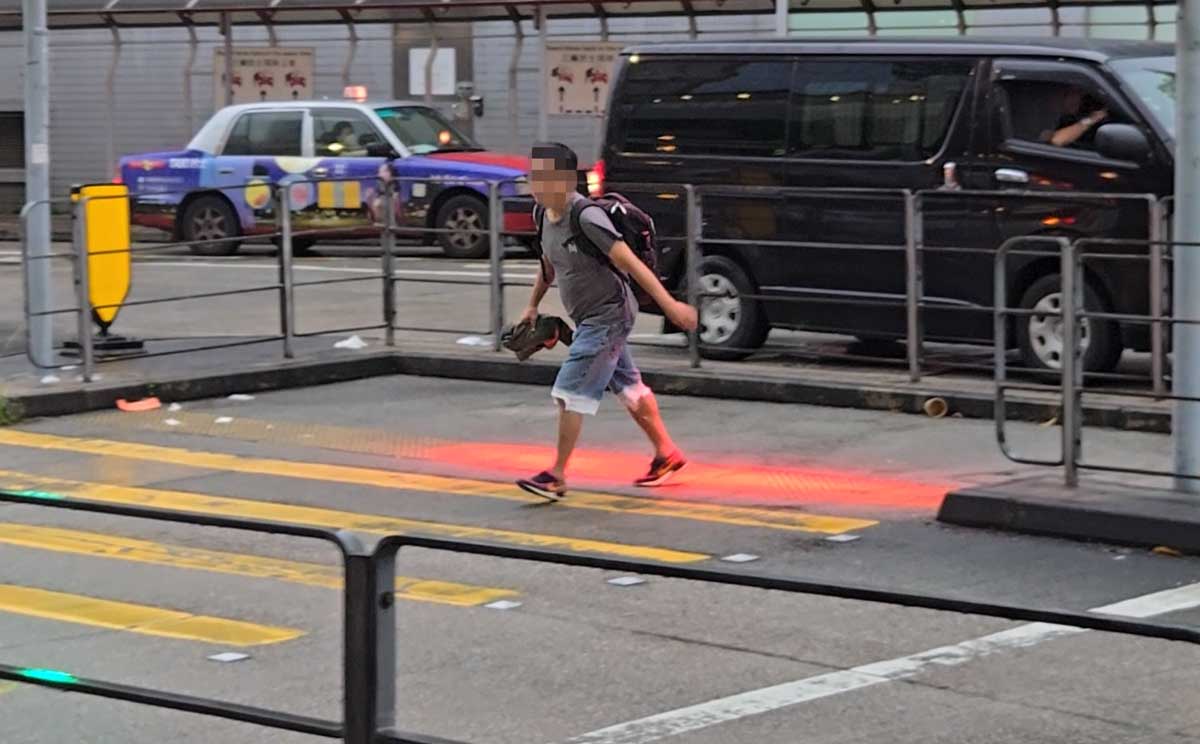
Even when visible at dusk or in cloud, as seen here on Tim Fuk Road, pedestrians crossed over the projected red light
This phenomenon also gave rise to a counterintuitive increase in RMCs at some crossings where the lights were installed and visible. For example, in Kowloon Tong around Tim Fuk Road we found an average 16.2% RMC rate when the lights were invisible: but this increased to 22.6% when the lights were visible at dusk or under dark cloud.
More people crossed against the light when the so-called safety system was working.
One theory is the added “security” of the red light – and the extra traffic check it prompted in those pedestrians – gave pedestrians more confidence. Once they were halted by the light, checked the road and saw no traffic, they might have felt they were safe to proceed. Without projector lights, the general behaviour of most pedestrians is simply to stop and wait for the green man signal – citywide, only one in five cross against the green man, no matter the crossing technology deployed.
We also found, anecdotally, a “peer effect”. If a large crowd was waiting for the green man but one pedestrian broke rank, around 10% of the crowd would join them. Individuals wishing to play their part in road safety should take note.
“Inelegant solution”
The red projector lights have been controversial since their introduction, with experts saying it puts too much onus on pedestrians.
One called the system “inelegant”. He raised the issue of the invisible lights during daylight hours and said cutting speed at pedestrian crossings would have a much greater safety impact.
Many urban areas have cut traffic speed to a maximum of 30kph, giving pedestrians struck by vehicles much better odds of survival.
A traffic marshal at a Kowloon Tong school said the lights were a good idea but added the oft-heard complaint that they “didn’t work” in the sunshine.
And councillors at Kwai Tsing District Council have lambasted the scheme as confusing and dangerous.
Councillors in June complained that TD had fitted the lights with “no consultation” of the council, and that the red lights “are more dazzling and may make pedestrians waiting to cross feel uncomfortable.”
Kwai Tsing councillors also said drivers were “confused and surprised” to see the red lights; and that the lights had been installed at a relatively safe crossing, given two recent fatal pedestrian crashes just a few hundred yards away from the chosen crossing.
Councillors expressed disappointment that TD sent no representative to a meeting to discuss the issue, while TD pledged to send experts to discuss the issue at the next Traffic & Transport Committee meeting.
Back in 2022, TD’s chief engineer Alex Au Ka-kit told an RTHK programme that authorities were learning from experience on the mainland and overseas and that over half of fatal incidents on road crossings were related to “pedestrian behaviour”.
A survey then by Transit Jam found two-thirds of “green man” crossings at the pilot site on Percival Street were blocked by red-light skipping drivers.
But despite controversy, the new devices are already ordered and under installation across the city. The government says, in view of the “positive effect of the auxiliary devices on pedestrian safety” it will continue its rollout, with around 650 devices installed at 100 locations as of 13 August 2024.
TD will focus on “blacksite locations with higher number of accidents involving vehicle-to-pedestrian collisions in the past,” it says.


A very interesting article. Setting aside their effectiveness, I think it would have been better to put lights in the ground that shine up. The frame to hold the lights clutters open space
I’ve seen ground-fitted ones in Seoul, much neater and likely more effective/visible. The current ones indeed make the sky very ugly!